
Accurately estimating shading losses in large-scale photovoltaic plants remains one of the biggest challenges in PV modeling. Conventional approaches often rely on full I-V curve calculations or ray-tracing, which are computationally demanding, while simplified methods risk over- or underestimating shading effects.
To address this challenge, our team at SUNVEON developed the Sunveon Model — a novel, efficient approach that combines a 2D irradiance model with a 3D submodule-level shading model. Its key innovation lies in the ability to predict each string’s Maximum Power Point (MPP) directly through a regression model validated against more than 500,000 I-V curves, achieving up to 93% faster yield simulations for >70 MW plants (and ~75% faster for 5 MW systems) compared to full I-V curve calculations — without compromising accuracy.
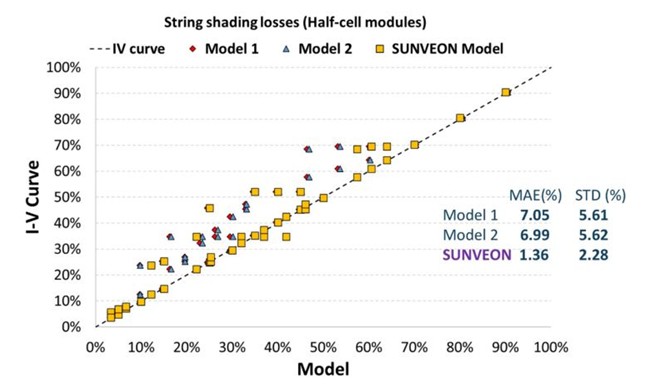
For half-cell modules, the Sunveon Model reached MAE 1.36% / STD 2.28%, versus approximately 7% MAE / 5.6% STD in two widely used industry models.
The study also introduces the concept of a Mixed Fill Factor, which establishes a direct quadratic relationship between mismatch losses, shadow percentage, and irradiance. As a result, standard-cell modules show ~64% higher mismatch losses than half-cells, underscoring how module topology directly influences performance under partial shading. This piece of research was officially presented to the scientific community at EU PVSEC 2025, within the session “Predicting Shading Losses in Photovoltaic Plants: A Novel Approach.”
| Title | Predicting Shading Losses in Photovoltaic Plants: A Novel Approach. |
| Author(s) | Daniel López Dalmau, Haritz Mirandona López, Carlos Javier Lopes Gomes, Joan Tomás Villalonga Palou, Carlos Rossa |
| Abstract | Accurately estimating shadow impact on large-scale photovoltaic (PV) plants is challenging due to the computational demands of traditional methods. This study introduces the Sunveon Model, a novel, efficient approach for simulating shading and mismatch losses without requiring complex I-V curve calculations. The model uses a hybrid methodology, combining a 2D irradiance model with a 3D submodule-level shading model. Its key innovation is the use of a regression model, whose accuracy was validated against over 500,000 I-V curves, to directly predict a string’s Maximum Power Point (MPP), significantly reducing computational time. It also quantifies mismatch losses with a new ‘Mixed Fill Factor’ that establishes a direct quadratic relationship between losses, shadow percentage, and irradiance. Validated against real-world data, the Sunveon Model proved more accurate than two industry-standard models, showing substantially lower errors. A key finding is that mismatch losses for standard cells are about 64% higher than for half-cell modules. In summary, the Sunveon Model offers a precise and efficient tool for large-scale PV analysis. |
Access the paper on the EU PVSEC website here, or download the PDF directly HERE.
