
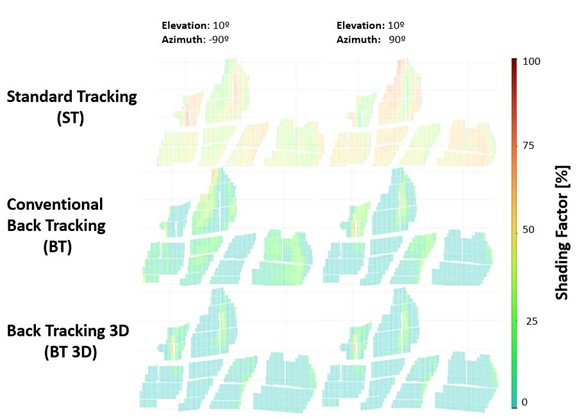
Backtracking strategies are widely used in photovoltaic (PV) plants to minimize mutual shading, but they often fall short on the irregular terrains typical of large-scale projects. Conventional algorithms assume uniform slopes, which limits their accuracy in representing the diverse topography of real PV sites — and ultimately reduces energy yield.
To overcome these limitations, our team at SUNVEON developed Backtracking 3D, a new slope-aware tracking strategy that uses Machine Learning clustering to divide the terrain into zones with similar characteristics. Each cluster adapts tracker rotation to its local slope and solar position, optimizing orientation for higher irradiance capture. The method also integrates Brent’s optimization algorithm to fine-tune rotation angles under diffuse light conditions, maximizing energy yield even in complex or overcast scenarios.
Validated across five real PV plants in Spain, Backtracking 3D delivered consistent gains:
- +2.6% energy yield vs. standard tracking, and +1.7% vs. conventional backtracking.
- 10,000–100,000× less computing power required than ray-tracing methods, while remaining compatible with standard design tools such as shading tables.
- Robust performance across climates, with monthly gains ranging from +1.7% to +6%, depending on location and conditions.
This piece of research was officially presented to the scientific community at EU PVSEC 2025, within the session “Backtracking 3D: A Novel Approach to Conventional Backtracking Algorithms.”
| Title | Backtracking 3D: A Novel Approach to Conventional Backtracking Algorithms for Improved PV Performance in Complex Terrains |
| Author(s) | Joan Tomás Villalonga Palou, Daniel López Dalmau, Haritz Mirandona López, Carlos Javier Lopes Gomes, Carlos Rossa |
| Abstract | Backtracking strategies are widely used in photovoltaic (PV) plants to reduce shading, but they become ineffective on the irregular terrains typical of large-scale installations. Slope-aware approaches improve performance but rely on simplified terrain models, which fail to represent the diverse slopes of real PV layouts. As a result, current methods remain limited in mitigating shading losses, reducing irradiance capture, and lowering overall energy yield. To overcome these limitations, an innovative tracking strategy based on Machine Learning is proposed to optimize the performance of PV plants in complex terrains |
Access the paper on the EU PVSEC website here, or download the PDF directly HERE.
